TLDR: “Little Garden” is an ongoing, multi-platform journaling project I started as a way to investigate art, media, and daily life as they engage with the paradox of of nature within the built environment.
I spent most of this past winter depressed and watching a lot of anime. “A lot” is a loose unit of measurement—elastic, subjective. For me—someone who didn’t start watching anime until 25, who works regular hours, pays rent on time, and maintains a stable relationship with another human being—it felt substantial. For someone else, it might not even be worth mentioning. It was enough to finally catch up with the current arc of One Piece, arriving right on cue for the animation studio’s announcement of a six-month break—a fitting reward for having spent the last two years of that otherwise busy adult life working through roughly 1,150 episodes in circulation since 2001.
On a particularly uninspired evening, I decided to give the Netflix live action an honest shot. I went in expecting it to be unwatchable—even by the standards of someone who unironically enjoys reverse harems like Ouran High School Host Club—and allotted it ten minutes. At least I could say I gave it a college try. I have no regrets going into it with a pessimistic view, for it was, in fact, very cringe. But not unwatchable. And, against my better judgment, more fun than I expected. Ten minutes stretched into ten hours. Somewhere in that span, I found myself wiping away fat crocodile tears over a CGI reindeer and the unapologetic brutality of their backstory. By the time it was over, I wanted more. So I returned to the anime, picking it up where the live action left off. And here we are—watching one of the longest-running anime in the world, again.
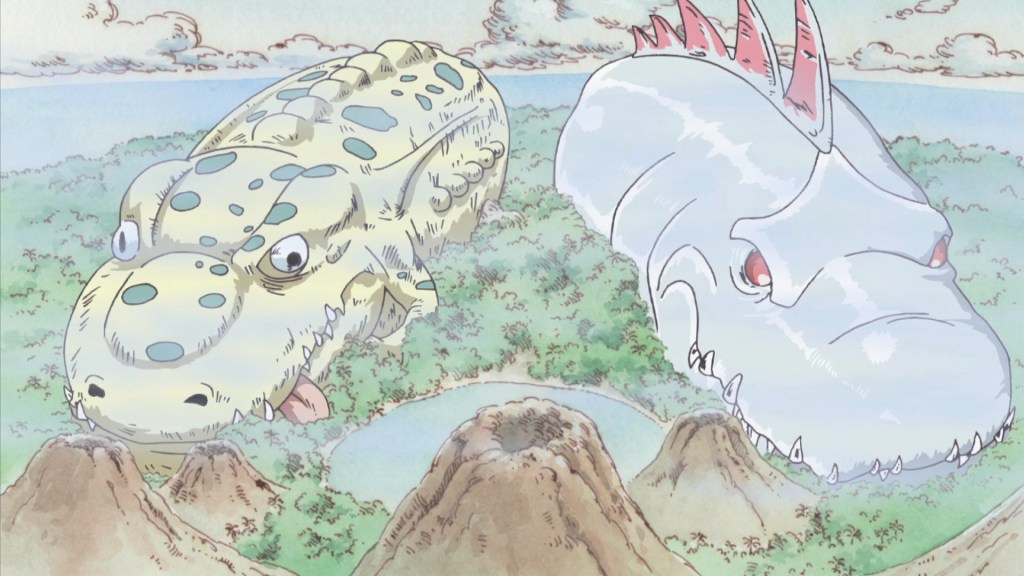
Through this spiritual journey, I was reminded of an arc in early One Piece titled Little Garden. During one of their first stretches across the Grand Line, the Straw Hat crew stumbles onto what can only be described as a feral wilderness—an untouched, vaguely prehistoric island, marked from a distance by two identical mountains that seem to take up most of the available landmass. Little Garden is also home to active volcanoes, and to an ecosystem that feels hostile and exaggerated to the point of parody: oversized, carnivorous flora, hulking animals, everything just slightly out of scale. Having been told the island’s name before arriving, both the Straw Hats—and the viewer—are set up to imagine something else entirely. Something smaller, quieter, more contained. A garden, in the way we’ve agreed to understand it. Instead, you get Sanji karate-kicking a T-Rex in the face hard enough to presumably kill it on impact. It’s not that this kind of thing is out of place for One Piece—it isn’t. But it does feel out of place for a garden.
Major spoilers ahead: The Straw Hats eventually discover that the island is inhabited by two giants, long abandoned by their crew and locked in a century-long duel. For them, Little Garden isn’t an island so much as it is a battleground—steady, uninterrupted, and apparently where time isn’t a major factor. Those two massive mountains dominating the landscape aren’t actually mountains at all, but the skeletal remains of two Sea Kings, each slain by one of the giants. The duel itself began as a dispute over which of them had killed the “bigger” beast. To settle it, they dragged the bodies ashore and laid them side by side for comparison. They never reached a conclusion. Instead, the bodies stayed. They decayed, collapsed, and slowly became part of the island itself—absorbed into the terrain, repurposed as the foundation for everything that would grow there. What looks like landscape is, in part, aftermath.
All of this mostly serves to clarify scale. These giants aren’t just large—they operate at a size where entire ecosystems can emerge from the remains of their arguments. And it turns out they were the ones who named the island Little Garden. From their perspective, it wasn’t ironic. It was accurate.
The story of Little Garden proposes a quiet kind of paradox: we don’t just shape nature—we reduce it, conceptually, to something we can live with. What’s at stake isn’t physical scale so much as authority over meaning. The giants don’t make the island small; they decide that it is, and in doing so, fix its identity through perception alone. It’s not so different from what we do. We label places as parks, yards, green spaces—terms that make them legible, manageable, easy to hold in the mind. But in the process, something narrows. The imagination contracts. Our relationship to those spaces becomes structured in advance. At a certain point, it starts to feel like there’s no such thing as an uncurated landscape. Only spaces that have been named, bordered, and understood into submission.
This arrives us at the conditions of our current environmental epoch—what some scholars have labeled the Anthropocene.
Grounded in this paradox, the blog brings together a range of written and visual entries—essays, prose, artwork, photographic documentation, borrowed media, alongside fragments pulled from daily life. Through habitual errands, commutes, outings, and projects, moments of discovery emerge—small, often overlooked encounters that reveal our own “little gardens.”
Image Credit: Eiichiro Oda, One Piece
 Little Garden