One of the least charming and yet most defining features of our modern civilization is that there’s always a McDonald’s within a very reachable distance. More reachable than any grocery store, hospital, or park. Stuck in a food desert? No problem, there’s a Happy Meal waiting just a stone’s throw away. My trusted golden arches are located on Hiawatha Ave and 41st in South Minneapolis. My reasons for liking this particular McDonald’s is actually just one—it’s close by. For a narrow variety of impulsive yet apathetic, self-regulating, hunger-adjacent reasons, I’ve clocked in many runs to this drive thru. So many in fact that I’ve run out of things to look at.
If you find yourself stalled in this particular lane, nugs and fries pending, consider pivoting your sightline the opposite direction from the service window. On the right-hand side, you’ll notice that there are green, leafy vines concealing a short, metal fence. If the first time you witnessed this lush fence were in the warmer months, you might not think anything of it. You probably wouldn’t even notice it long enough to think that it’s a thing worth looking at. The first time I noticed this vining fence, I noticed it right away, and not because I’m especially perceptive, but because it was the middle of January and it was in fact, still green.
Minnesota winters reduce the world to white, gray, and road-salt brown—not typically green. Actually, never green. In what world is there a green ivy fence in negative 30 Fahrenheit? Oh right, dummy (me), it’s a fake fucking fence. No, it’s a microplastic blanket. Astroturf shag carpeting for vertical surfaces. A cosmetic solution that only works for half of the year. Now that I’ve seen it, I can’t unsee it. I also can’t avoid it. Going to another Mcdonalds risks cold nuggets by the time I get home, which is worse than throwing money down the toilet and not eating at all.
But the good news is that we are now entering peak season for fake ivy fences.
Come spring and summer, the distinction between organic and artificial starts to blur under humidity and overgrowth. Weeds split concrete open. Vines crawl over chain link fences honestly. Trees hide power lines. Even abandoned buildings look temporarily alive.
But Upper Midwest winters are unforgivingly forensic. They strip objects down to their bare bones. Metal becomes metal again. Concrete is concrete. Dead grass compresses under the ice into lifeless fibers of beige. Any surviving color feels suspicious.
And so the fence glows in January like a rendering error.
Not even an especially convincing one, either. The leaves are too evenly saturated, too dense, the distribution too mathematically calculated across the wire frame. Real vines sag. They die unevenly. They get damaged by fence-hoppers. Their structure eventually gets exposed. But this thing refuses entropy entirely. It’s the middle finger of corporate evergreen. A downright offensive simulation of concealment.
Which raises the question: what exactly are they trying to hide?
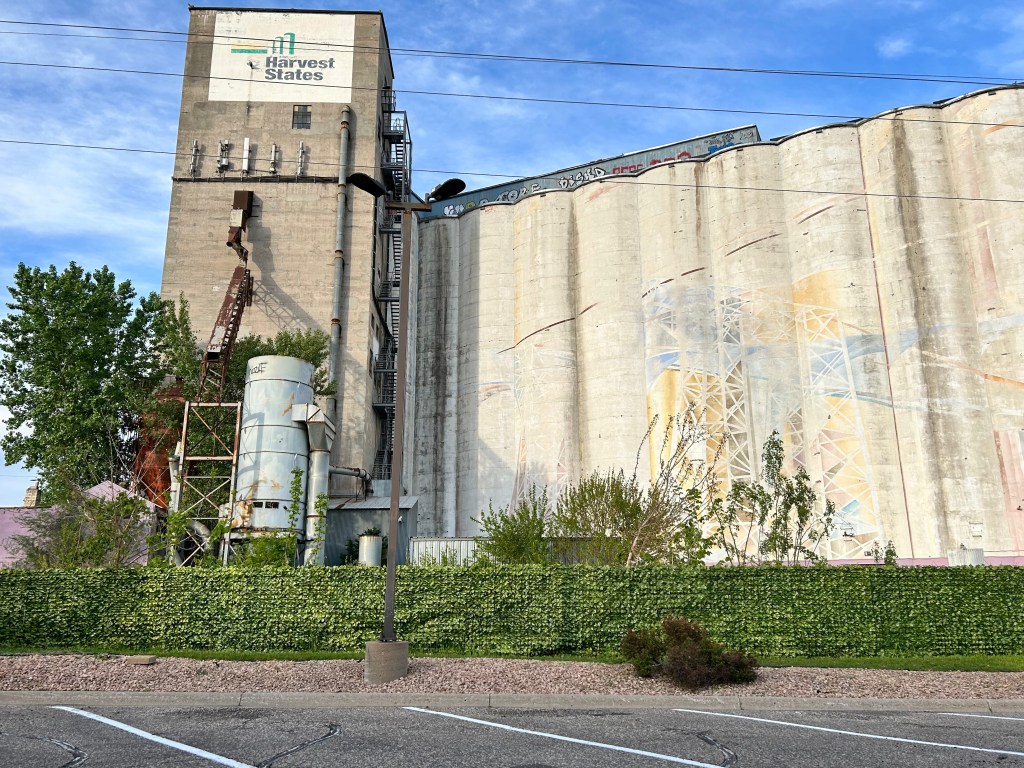
Hiawatha Ave in South Minneapolis serves as both a dividing line between Longfellow and Powderhorn and as an aging industrial corridor. Over the past few decades, chain businesses have gradually filled in around the towering grain silos that once economically defined the area. I saw in a Star Tribune article the silos described as “cliffs crafted by a million years of graceful erosion, or remnants of an early civilization that loom over the modern streets like the pyramids…They make the Bastille look like Versailles.” (1)
The grain silos themselves are incredible in the way all dead industrial structures are incredible — too large to emotionally process correctly. They rise behind the McDonald’s like abandoned monuments to a civilization only slightly older than ours. You can imagine an entire neighborhood once orienting itself around them: shifts beginning before sunrise, freight trains rattling through the corridor, the smell of grain dust in winter jackets and car interiors. Now they loom over a parking lot where people idle in clapped Toyota Camrys waiting for big macs. All the while, the metro Blue Line slides on by shuttling airport travelers to downtown Marriotts and overworked MOA retail workers home.
The fake hedge doesn’t actually conceal the silos. If anything, it frames them. It draws your attention directly toward the contrast. Here is a billion dollar global franchise attempting to cosmetically smooth over the psychic gap between economic eras using the cheapest possible materials available.
And I think that’s why I love it.
Because it fails so completely.
Not in the practical sense — I’m sure someone approved it after a brief facilities meeting and called the problem solved. But aesthetically, spiritually, seasonally, it completely collapses under scrutiny. It’s an object built entirely for passing glances cruising at 10 miles per hour. The moment you’re trapped beside it in a drive-thru line long enough to actually look, the illusion falls apart.
– G
Citations
- Lileks, J. (2015, April 6). Streetscapes: Urban giants are pyramids of the prairie. The Minnesota Star Tribune. https://www.startribune.com/urban-giants-are-pyramids-of-the-prairie/294407941/
 Little Garden